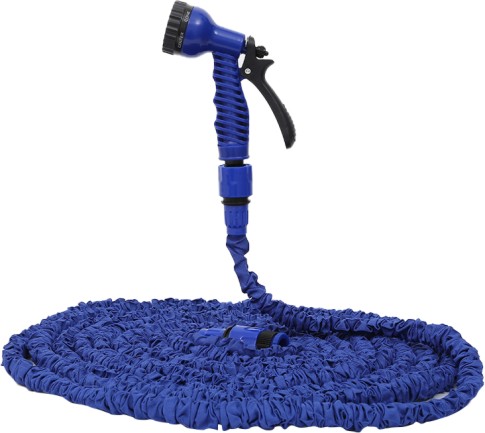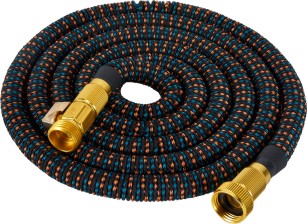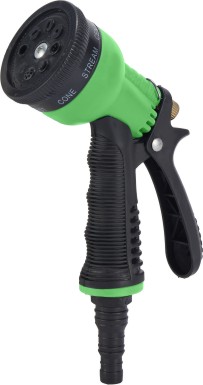
Why Getting Spray Gun Selection Wrong Is Costly
A poor spray gun choice generates the three most expensive outcomes in Amazon selling: high return rates, negative reviews, and lost repeat orders. In a category where buyers have already purchased a hose and are evaluating nozzles based primarily on reviews and price, the product itself has to perform — there is no room to recover from a design specification error post-launch.
This guide breaks down the 6 performance criteria that matter most, based on sourcing patterns from Linzun Tools' factory in Yongkang, Zhejiang — the production hub responsible for the majority of garden hose accessories exported globally.
Criterion 1: Body Material and Construction
The spray gun body must withstand UV exposure, thermal cycling (−20°C to +60°C for outdoor storage), and repeated drop impacts. The three standard materials are:
- ABS Plastic: Lowest cost ($0.80–1.80 body cost at scale), lightest weight (80–130g), available in any color. Service life 1–3 years outdoors. Suitable for budget retail and seasonal products. Brittle at temperatures below −10°C.
- ABS + TPR Overmold: ABS structural body with thermoplastic rubber grip surfaces. Improves drop resistance and perceived quality significantly. Adds $0.30–0.60 to body cost. Currently the bestselling construction for mid-tier Amazon FBA products. Weight: 120–180g.
- Zinc Alloy (Die Cast): Premium standard. Body cost $2.50–5.50 at scale. Weight 220–380g (feels premium, but heavier for extended garden use). UV and impact resistant. Service life 5–8+ years. Enables higher retail pricing ($18–38 MSRP). Required for professional and trade channel distribution.
Recommendation: For Amazon FBA in the US/UK/EU mid market ($12–25 MSRP), ABS+TPR overmold provides the best cost-to-perceived-quality ratio. For premium positioning ($25+), zinc alloy is the only defensible option.
Criterion 2: Trigger Mechanism and Ergonomics
The trigger is the most-used mechanical component and the most common failure point. Key specifications:
Trigger Material
Plastic triggers (ABS) are standard in budget guns but fatigue and crack under repetitive use, particularly in cold weather. Zinc alloy trigger inserts extend service life by 3–5×. Full zinc alloy triggers are standard in professional models. From a sourcing perspective, requesting zinc alloy trigger inserts in an ABS-body gun is the highest-value upgrade available — approximately $0.50–1.20 additional cost.
Trigger Spring
The return spring determines trigger feel and long-term reliability. Factory-standard springs are carbon steel, which rusts in humid climates within 6–18 months, causing stiff or non-returning triggers. Stainless steel 304 springs add $0.08–0.15 each and eliminate this failure mode entirely. Always specify stainless return springs when sourcing.
Trigger Lock
A trigger lock (flow lock, comfort lock) maintains the trigger in the open position without sustained hand pressure. This is a standard feature in European markets and increasingly expected by US buyers. Lock mechanisms range from simple friction tabs to positive-latch slides. The positive-latch design (a separate button that engages the trigger) is preferred over friction tabs, which shift under vibration. Request positive-latch trigger locks for products targeting the US and EU markets.
Handle Grip Length and Diameter
Handle grip length of 130–150mm and diameter of 32–38mm fits 90% of adult hands comfortably. Ergonomic contouring (thumb rest, finger groove) improves perceived quality significantly for zero additional cost if your factory has the tooling. Check that grip length is sufficient to clear the hand from the hose connection when the gun is angled downward — a common usability issue in compact designs.
Criterion 3: Flow Control Range and Pattern Options
Flow control determines what tasks the spray gun can perform and what markets it serves. Two fundamentally different designs:
Discrete Pattern Selection (Rotating Collar)
A rotating collar moves between 7–12 pre-set patterns: Jet, Flat, Cone, Shower, Mist, Soaker, Foam, etc. This design is optimal for home gardening and general-purpose use. Users can select the pattern for their task and the gun maintains it. Best for: household retail, combo set packaging, general-purpose listings.
Continuous Flow Adjustment (Twist or Squeeze)
A twist adjustment at the nozzle tip or squeeze-force on the trigger provides infinite flow adjustment from off to full open. This design is optimal for car washing, precision rinsing, and professional applications where exact flow control matters. Best for: car care category, professional distribution, foam cannon pairing.
Note: Some premium designs combine both — a rotating outer collar for pattern selection and a front twist for flow intensity. These cost $1–3 more than single-mechanism designs but appeal to the premium multi-use segment.
Criterion 4: Inlet Fitting and Seal Quality
The inlet fitting connects the spray gun to the hose. Fitting quality determines leak rates, lifespan, and compatibility:
Fitting Material
- ABS plastic fitting: Budget standard. Prone to cracking when over-tightened or frozen. Adequate for light seasonal use.
- Zinc alloy fitting: Durable, precise threads, no cracking. Standard for mid-to-premium guns.
- Full brass fitting: Maximum corrosion resistance. Mandatory for potable water contact and professional irrigation.
O-Ring and Gasket Specification
The inlet O-ring seals the connection between hose and gun. Standard factory spec is NBR 70 Shore A — adequate for clean fresh water. For markets with heavily chlorinated municipal water (US, UK, Australia), EPDM seals are recommended — more resistant to ozone and chlorine degradation. The difference: NBR O-rings may show visible cracking after 2–3 years of chlorinated water exposure; EPDM lasts 5–7+ years under the same conditions. Cost impact: $0.05–0.10 per unit. Specify EPDM in your purchase order.
Thread Standard
Confirm target market thread standard before placing any order — this is the most common sourcing mistake for first-time importers:
- USA/Canada: 3/4" GHT (11.5 TPI, ACME thread form)
- UK/Ireland/Australia: 3/4" BSP (BSPP, 14 TPI, 55° thread form)
- Continental Europe: BSP or Gardena quick-connect (specify based on retailer requirements)
- Japan: G3/4 (JIS, BSP-equivalent)
Criterion 5: Working Pressure Rating
Working pressure rating indicates the maximum supply pressure the gun can safely handle without leaking or component failure. Standard residential supply pressure is 40–80 PSI (2.8–5.5 bar) in North America and 2–4 bar in Europe. Minimum recommended rating for retail products: 8 bar (116 PSI) — provides a 2–4× safety margin at typical supply pressures.
Products rated below 6 bar carry significant return risk in markets where older buildings or elevated water towers deliver higher pressures. Professional channel products targeting commercial cleaning or irrigation should carry 12+ bar ratings. Always request burst test documentation from your factory — reputable Yongkang suppliers test batches at 2× rated pressure before shipment.
Criterion 6: OEM Customization Options
For Amazon private label and branded wholesale accounts, customization scope determines how defensible your product is from competitor copying and how strong your brand identity can become in the listing.
Available Customization (Minimum 500 Pieces)
- Logo engraving: Laser engraving on body or barrel. Clean, durable. $0.10–0.25 per piece.
- Color matching: ABS bodies can be produced in any Pantone color at 500+ piece MOQ. Zinc alloy can be powder-coated or anodized to custom colors at 1,000+ pieces.
- Retail packaging: Individual printed retail box, blister pack, or poly bag with insert card. 500 piece minimums for box printing. Lead time adds 5–7 days.
- Combo bundling: Factory-assembled combos (hose + nozzle + accessories in retail box) reduce per-unit packaging cost vs separate items assembled in-market.
Tooling Requirements (Minimum 1,000–2,000 Pieces)
- Custom body shape or ergonomic contour changes
- Proprietary attachment mechanism or quick-connect standard
- Custom barrel diameter or length variation outside standard mold
Tooling fees range from $800–5,000 depending on part complexity and mold steel grade. Tooling is typically amortized over the first 2–3 orders and owned by the buyer after payment. Request mold ownership documentation when paying tooling fees.
Summary: Selection Matrix by Channel
| Channel | Body | Trigger | Seals | MOQ | Est. FOB Price |
|---|---|---|---|---|---|
| Amazon FBA Budget | ABS+TPR | ABS + SS spring | NBR | 200 pcs | $1.80–3.50 |
| Amazon FBA Mid-Premium | ABS+TPR or Zinc | Zinc insert | EPDM | 500 pcs | $3.50–7.00 |
| Wholesale / Brick & Mortar | Zinc Alloy | Full Zinc | EPDM | 500 pcs | $5.00–10.00 |
| Professional / Irrigation | Zinc / Brass | Full Zinc/Brass | EPDM | 300 pcs | $8.00–18.00 |
| Car Care / Auto | ABS+TPR or Zinc | Zinc insert + lock | EPDM | 500 pcs | $4.00–9.00 |
Getting Samples Before You Commit
Before placing a production order, always test samples against your criteria checklist: trigger operation under sustained use (200+ pulls), O-ring leak test at full supply pressure for 30 minutes, UV exposure test (optional for accelerated lab testing), and drop test on concrete from 1.5m height. Reliable Yongkang factories ship samples within 3–5 business days. Sample shipping cost is typically on buyer account; it is credited against the first production order for orders over 500 pieces.
Looking for a reliable expandable garden hose supplier?
Get a free sample shipped within 5 business days. MOQ from 200 pcs. OEM packaging available.