The 8 Core Spray Patterns — What Each Does and When to Use It
Garden hose nozzles are categorized primarily by their spray pattern — the shape and behavior of the water stream they produce. Understanding these patterns is essential for matching products to the right market segment, writing accurate Amazon listings, and sourcing the correct nozzle type for your target customer.
The following comparison covers the 8 most commercially important spray patterns stocked by Yongkang factories, with flow data measured at standard residential supply pressure (50 PSI / 3.5 bar).
Spray Pattern Comparison Table
| Pattern | Shape | Approx. Flow Rate | Spray Width @ 1m | Primary Use Cases | Target Market |
|---|---|---|---|---|---|
| Jet | Concentrated single stream | 4–7 GPM (15–26 L/min) | 1–3 cm | Driveways, reaching high areas, drains | Home + Commercial |
| Flat | Horizontal fan, narrow angle | 3–5 GPM (11–19 L/min) | 20–40 cm | Washing vehicles, walkways, siding | Home + Auto |
| Cone | Solid cone, 30–45° angle | 2–4 GPM (8–15 L/min) | 30–60 cm | Lawn watering, plant beds, general rinse | Home Garden |
| Fan | Wide flat fan, 60–90° angle | 2–4 GPM (8–15 L/min) | 60–120 cm | Lawn coverage, seedbeds, shrubs | Garden / Landscaping |
| Shower | Gentle downward spray, hollow cone | 1–3 GPM (4–11 L/min) | 20–40 cm | Seedlings, flowers, washing pets/hair | Home Garden + Pet |
| Mist | Fine atomized spray, 90–120° cone | 0.5–1.5 GPM (2–6 L/min) | 50–100 cm | Delicate seedlings, humidity, outdoor cooling | Garden + Greenhouse |
| Soaker | Single low-pressure stream | 2–3 GPM (8–11 L/min) | 1–5 cm | Filling buckets, deep root watering | Home + Agriculture |
| Foam / Soap | Aerated, low velocity stream | 1.5–2.5 GPM (6–9 L/min) | 5–15 cm | Car washing, boat washing with detergent | Auto + Marine |
Nozzle Body Materials: What Drives Price and Durability
The material used for the nozzle body is the single most important factor determining product life, price tier, and appropriate market positioning. Yongkang factories produce nozzles in three primary body materials:
ABS Plastic Nozzles
ABS (Acrylonitrile Butadiene Styrene) plastic is the lowest-cost option and dominates the budget segment. At FOB Ningbo pricing, ABS 7-pattern nozzles typically run $1.20–2.80 each at 500+ piece quantities. They are lightweight (80–120g) and colorful, which appeals to retail buyers. Key limitation: ABS becomes brittle with UV exposure after 12–18 months outdoors and cracks when dropped at temperature extremes. This drives a high replacement cycle — good for volume sellers, bad for brand reputation builds.
Zinc Alloy (Zamak) Nozzles
Zinc alloy, also called Zamak (zinc + aluminum + magnesium + copper), is the premium standard for mid-to-high retail and professional applications. Weight increases to 200–350g but durability rises dramatically — zinc alloy nozzles regularly last 5–8 years in outdoor use. Die-casting allows complex ergonomic shapes that feel premium in hand. FOB price range: $3.50–8.00 for 7–10 pattern nozzles. This material drives the highest-rated Amazon listings in the category. Zinc alloy nozzles account for roughly 65% of Linzun Tools' nozzle export volume.
Brass Nozzles
Pure brass nozzles are the professional choice where corrosion resistance is paramount — irrigation systems, coastal climates, and chemical fertilizer applications. Brass does not corrode, maintains dimensional stability in temperature extremes, and is the only material reliably safe for potable water contact (relevant for drinking garden hose use cases). Premium brass 4–6 pattern nozzles FOB price: $6–15. The weight (300–500g) limits mass-market appeal but commands loyalty in professional and irrigation segments.
The 4 Most Commercially Important Nozzle Categories for B2B Buyers
1. Multi-Pattern Thumb-Control Nozzles (7–10 Patterns)
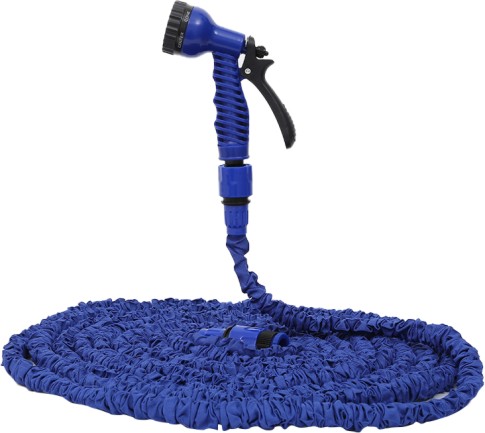
These are the bestselling nozzle category on Amazon globally. A rotating collar or thumb slide moves between spray patterns. The 7-pattern variant (Jet / Flat / Cone / Fan / Shower / Mist / Soaker) is the sweet spot for most markets. Amazon BSR data from the Garden category (US) consistently shows multi-pattern zinc alloy nozzles with ergonomic grips outperforming all other nozzle types in units sold and star ratings. For OEM buyers, pairing these with a branded expandable hose creates the highest-conversion combo listing.
2. Adjustable Spray Gun / Pistol Grip Nozzles
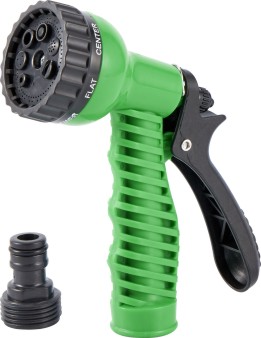
Pistol-grip spray guns with a single adjustable flow control (twist-to-spray or pull-trigger) are the car-washing segment's standard. They typically offer infinite flow adjustment rather than preset pattern clicks. The trigger lock mechanism is a key spec — high-quality guns use stainless steel springs and zinc alloy triggers; budget versions use ABS and short-life springs. Professional car wash operators and detailing supply distributors purchase these in quantities of 1,000–5,000 pieces per order. FOB price: $2.50–12 depending on body material and features.
3. Foam Cannon / Soap Nozzles
Foam cannons integrate a detergent bottle (usually 1L capacity) with a venturi mixing chamber that draws soap into the airstream. The resulting thick foam adheres to vehicle surfaces for improved contact time. This category has grown rapidly on Amazon (US, UK, Australia) following the car care content wave on YouTube. Key spec: foam cannon nozzles require a minimum 40 PSI supply pressure to generate adequate foam. Premium stainless steel internal components prevent corrosion from soap concentrates. FOB price for complete foam cannon: $4–18.
4. Pressure-Boosting Nozzles
These nozzles use a venturi or restriction principle to increase exit velocity above supply pressure. They are marketed as "high pressure" or "power wash" style nozzles for consumers who want more force without a pressure washer. Exit pressure can reach 2–3× supply pressure at the cost of reduced flow rate. Popular in European markets where residential water pressure is often lower (2–3 bar vs 4–6 bar in North America). FOB price: $2–6 for ABS versions, $5–15 for zinc alloy.
Thread Standards by Market: Critical Sourcing Detail
Thread compatibility is often overlooked by first-time importers and creates the most common product return reason in this category. Every nozzle must match the thread standard of the target market's outdoor faucet and hose fittings:
| Market | Standard | Specs | Notes |
|---|---|---|---|
| USA / Canada | GHT (Garden Hose Thread) | 3/4" — 11.5 TPI | Non-compatible with BSP without adapter |
| UK / Ireland | BSPP (British Standard Pipe Parallel) | 3/4" BSP | Hozelock connector system also common |
| Europe (Continental) | BSPP or Gardena System | 3/4" BSP + Gardena quick-connect | Gardena system dominant in Germany/France |
| Australia / NZ | BSP or Pope System | 3/4" BSP | Pope quick-connect widely adopted |
| Japan | G3/4 (JIS B 0203) | 3/4" BSP equivalent | Takagi/Caro connector systems common |
Yongkang factories can produce nozzles to any of these thread standards. Always confirm thread specification when ordering, as the molds are different and cannot be switched mid-production run.
Sealing Materials: O-Rings and Gaskets
The internal sealing system prevents leaks at the inlet connection and between pattern-change positions. Factory-standard seals are NBR (Nitrile Butadiene Rubber), suitable for temperature range −30°C to +100°C and resistant to light oil contamination. For chlorinated water markets (most of North America and Europe), EPDM seals are preferred — more UV and ozone resistant but slightly more expensive. High-end nozzles use PTFE-backed seals for maximum chemical resistance. Seal failure is the most common cause of 1-star Amazon reviews in this category; specifying upgraded EPDM seals adds roughly $0.15–0.30 per nozzle.
Sourcing Checklist for Nozzle Buyers
- Confirm thread standard: GHT (USA/Canada) or BSP/BSP variant (EU/AU/UK)
- Specify body material: ABS (budget), Zinc alloy (mid-premium), Brass (professional)
- Pattern count: 7–10 patterns for general retail; 3–5 for professional focused use
- Seal material: NBR standard; EPDM recommended for chlorinated water markets
- Working pressure rating: Minimum 8 bar (116 PSI) recommended for retail
- Flow rate at jet: Request test data at 40 and 60 PSI supply pressure
- Certifications: CE marking required for EU; California Proposition 65 compliance recommended for US
- Customization scope: Logo position, color options, packaging type, combo pairing
Minimum Order Quantities and Lead Times
Standard 7-pattern ABS nozzles: MOQ 200 pieces. Zinc alloy multi-pattern nozzles: MOQ 500 pieces. Custom color or shape tooling: 1,000–2,000 pieces + tooling fee. Custom retail packaging: 500 pieces additional minimum. Standard lead time: 15–20 days. Custom tooling lead time: 25–40 days. Samples available within 3–5 business days from our Yongkang factory stock.
Looking for a reliable expandable garden hose supplier?
Get a free sample shipped within 5 business days. MOQ from 200 pcs. OEM packaging available.